
🚨Urgent: Missile Strikes Shelter in Ukraine! Rush Emergency Aid!
Rescue Team Races To Save Owl Pulled From Concrete Mixer
Matthew Russell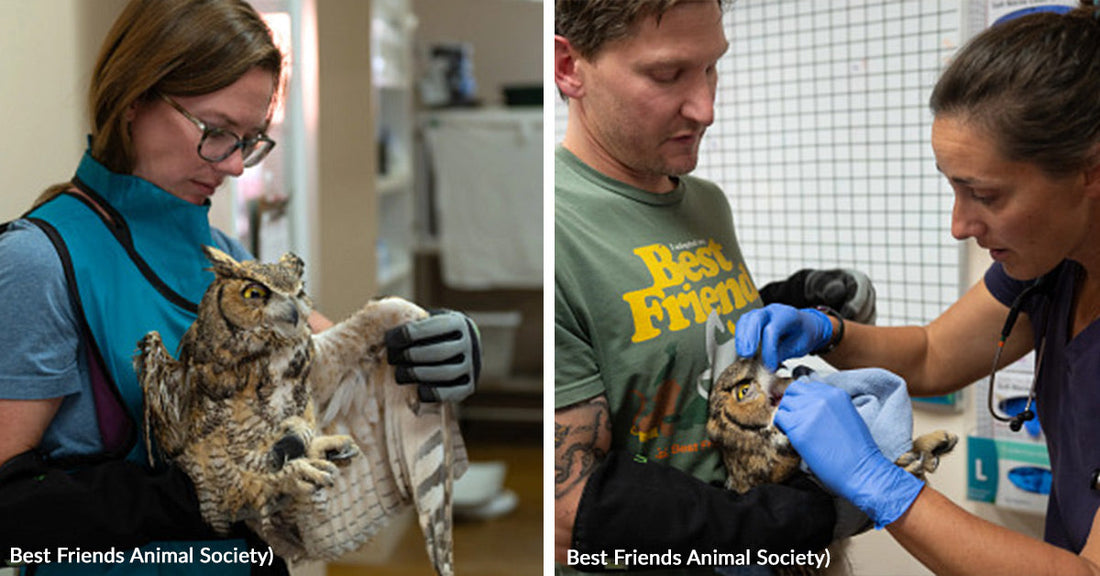
A great-horned owl in southern Utah survived an ordeal few wildlife rescuers had ever seen. The young bird slipped into a concrete mixer at a construction site and emerged with dried cement coating about a quarter of his small, two-pound body.
Staff at the Wild Friends rehabilitation center in Kanab said they had never treated anything like it, and neither had any other rehabilitators they contacted, according to Best Friends Animal Society.
Wild Friends supervisor Bart Richwalski recalled the team’s surprise.
“Our first reaction was ‘what are we going to do with this guy?’ but we were also a little excited for the challenge,” he told The Animal Rescue Site.

Photo: Best Friends Animal Society
Bart Richwalski, Wild Friends Supervisor at Best Friends Animal Sanctuary and veterinarian Kelsey Parras examine the owl.
A Delicate escue Plan
The team needed a method that would strip away concrete without damaging feathers already frayed by the cement. After urgent research, they settled on a slow, daily routine: 20-minute warm-water baths under anesthesia. For several days, staff used warm water, gentle tools, and even toothbrushes to lift the concrete off layer by layer, CBS News reports.
Chief Sanctuary Officer Judah Battista said the bird’s case demanded creativity.
“This was a brand-new situation for the Wild Friends team and they really stepped up to the plate to do their best for this owl,” he told PEOPLE.
Richwalski said the most delicate moments came when they had to work near the owl’s face.
“The most challenging part was the removal of larger pieces of concrete on his face—near his mouth, eyes, and nares,” he said. “It was crucial to remove those first, and we had to use tools to break apart the large pieces, which was nerve wracking since they were near very vulnerable areas.”
The team also worried about whether the owl had swallowed any concrete.
“We questioned if he would make it at first because we didn’t know if he ingested any concrete, but X-rays showed that he hadn’t and that was a big relief,” Richwalski said. He added that the team improvised their method: “We essentially made up our own technique for removing the larger chunks… but we used the tried-and-true method of Dawn dish soap to do the cleaning.”

Photo: Best Friends Animal Society
The owl is a juvenile male.
Signs of Strength
Once the concrete was gone, the team watched for signs that the bird’s strength and balance were returning. Two weeks after the rescue, the owl managed flight again inside an aviary. According to UPI, staff later moved him from his indoor soft carrier to a larger outdoor enclosure.
The juvenile male soon cleared a key milestone: he flew to a six-foot perch on his own—a sign of regained muscle, control, and confidence.
Still, he cannot yet return to the wild. Great-horned owls rely on silent flight to hunt, and cement damaged the fine down that muffles the sound of their wings. Battista told CBS News that the bird now makes a “whooshing” noise in flight. He’ll need to molt next spring or summer before he can hunt safely.

Photo: Best Friends Animal Society
Staff worked to remove the concrete over several days.
The Road Back to the Wild
Richwalski said they expect to release the owl next year in a wooded habitat near the spot where he was found. The moment will mean more than a routine release.
“Releasing the owl will represent a huge success and reflect the dedication of our team to saving native species,” he said. “The team at Best Friends Animal Sanctuary is willing to go to the ends of the earth for wildlife.”
For now, the owl remains in the care of the nation’s largest no-kill sanctuary, surrounded by staff who built a rescue plan from scratch to give him a chance at survival.
