
Shelter Dog Once Facing A Final Day Returns A Year Later Looking Like A Whole New Life
Guest Contributor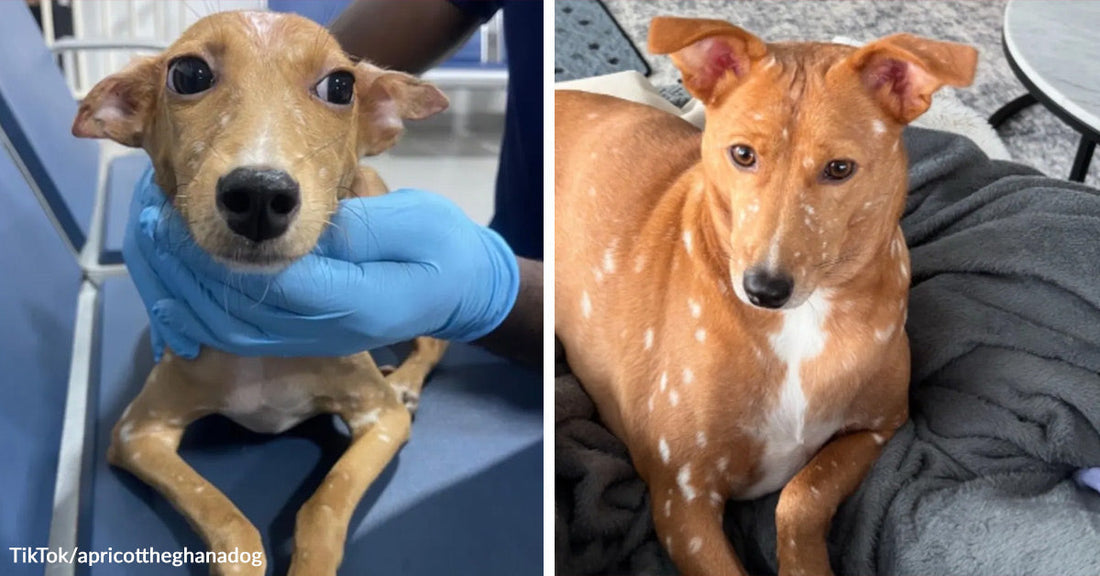
Some rescue stories are so dramatic that even a simple before-and-after photo feels almost unbelievable. The journey of Apricot, a rescued shelter dog from Ghana whose “last day” photo stunned the internet, is one of those stories. Her transformation from an emaciated puppy fighting for survival into a healthy, spotted dog that TikTok users compare to Bambi has captured hearts and brought new attention to the reality of stray animals worldwide. For anyone who loves inspiring animal rescue stories, Apricot’s tale reads like a global odyssey with a very happy ending.
Apricot’s story began in June 2024, far from the cozy homes and fenced yards many pets enjoy. She was discovered in a roadside gutter in rural Ghana, gravely ill and barely clinging to life. A young boy carried the tiny puppy into a compound where international volunteers were staying. Among them was Julia, a volunteer working with International Volunteer HQ who had traveled to Ghana to assist at schools in a community roughly two and a half hours from Accra. The area had several stray dogs who survived on scraps from volunteers, but even in that setting Apricot’s condition stood out immediately.

According to what Julia told Newsweek, the bond between them was almost instant. The puppy, weak yet eager for comfort, kept trying to climb into Julia’s lap. Beneath that small burst of affection, however, was a very serious medical crisis. Apricot had worms, cuts all over her body, and was showing clear signs that she might not survive much longer. Julia recalled that she believed the puppy had only a few days left. Apricot’s breathing was abnormal, and everything about her condition suggested she needed urgent help.
Resources were limited in the area, but Julia decided to try to save the puppy’s life. She traveled roughly two and a half hours to a veterinary clinic, where Apricot received treatment for a severe worm infestation and emergency medication. The visit stabilized the puppy, yet this was only the beginning. Saving a sick dog in a high-risk rabies country like Ghana involves far more than a single vet visit and a plane ticket home. International pet adoption from such regions comes with strict regulations, designed to protect both animals and humans.
Because Ghana is classified as high risk for rabies, there were clear rules about when and how Apricot could leave the country. The puppy was still only a few weeks old at the time she was rescued. She needed to reach at least six months of age, complete her vaccinations, and meet all import requirements before she could even begin her trip to the United States. With few alternatives, Julia arranged for Apricot to remain at the veterinary clinic’s shelter for an extended period, effectively turning the clinic into a temporary home and quarantine facility for the fragile puppy.
Months passed before Julia could return. When she came back to Ghana six months later, she found a puppy who had survived but not without cost. Apricot was now missing hair on the top of her head, a likely sign of the stress and strain of long confinement and earlier illness. She was still delicate and needed ongoing care. Yet she was alive, and that made the complex journey ahead feel worthwhile.
The trip that finally brought Apricot to the United States was a test of logistics and nerves. It involved multiple flights, including a leg through Togo, before arriving in Washington, D.C. Because of her size, Apricot had to travel in cargo rather than in the cabin. Julia reportedly felt anxious the entire time, worried that the puppy might be left behind or separated during the transfer. Despite those fears, both traveler and dog reached Washington on the same flight.
Arrival in the United States did not mark the end of Apricot’s medical challenges. She underwent more health checks and was treated for a tick-borne illness, which required another three days of quarantine. Only after this additional round of care and clearance could she continue on to her new home in New Jersey. It was there, surrounded by Julia, her family, and eventually another adopted dog, that Apricot’s recovery finally gained momentum.
As Apricot grew stronger, her appearance began to change in a way that surprised everyone around her. Rescued as a solid brown puppy, she gradually developed striking spotted markings across her coat. These markings are part of the reason people now compare her to a fawn or Disney’s Bambi. Julia’s family did not expect such a transformation, and the exact cause of her new look remains a bit of a mystery. DNA testing identified her as a West African village dog, which describes her origins but does not fully explain the dramatic shift in her coloring.
Today, more than a year after that desperate roadside rescue, Apricot is described as thriving. Her journey to becoming a “magical Disney dog,” as some TikTok users have called her, was not free of lingering health issues. She has undergone multiple surgeries to address luxating patellas, a condition in which the kneecap slips out of place. Each surgery required time, patience, and careful recovery. After months of healing, Apricot has settled into a comfortable life in New Jersey, where she enjoys the kind of safety and affection that once seemed out of reach.
The broader impact of Apricot’s rescue became visible when her story was shared online. A TikTok video posted on March 15 to the account @apricottheghanadog shows her dramatic “then and now” transformation. In the early photos she appears frail, injured, and heartbreakingly thin. In the more recent clips she is bright-eyed, healthy, and covered in those unique spotted markings that have inspired viewers to liken her to a deer. The video quickly gained attention, accruing more than 156,700 views, 40,000 likes, and nearly 100 comments.
Commenters responded with affection and amazement. Many fixated on her fawn-like appearance, with one person writing that "that is a fawn" and another joking about how cute the “pet deer” looked. Others focused on the emotional arc of the story, recognizing the effort and dedication that went into turning a critically ill puppy into a thriving companion. One commenter summed up what many seemed to feel, telling Julia that she had brought the dog “back to life.” I found this detail striking, because it captures both the physical and emotional dimensions of long-term rescue work.
Beyond the viral attention and the comparisons to beloved animated characters, Apricot’s story highlights the challenges that stray animals face in many parts of the world. It also underscores how international rescue efforts must navigate complex health regulations, long quarantines, and serious medical needs. Julia hopes, according to the reporting, that Apricot’s journey will draw more attention to these realities. When viewers pause to look past the cute “Bambi dog” clips and think about the path that led there, the story becomes not just heartwarming, but also thought provoking.
For animal lovers, Apricot’s transformation serves as a reminder that behind every rescue photo and viral video lies a mix of compassion, logistics, and perseverance. Her journey from a gutter in Ghana to a couch in New Jersey required months of planning, thousands of miles of travel, and many decisions that put her wellbeing first. The end result is a dog who not only survived, but flourished, and a story that encourages more people to see the potential in animals who, at first glance, appear to be in their very last days.