
EXTRA Good Points All Week for Guardians! Become a Guardian!
Loyal Hachikō Waited At Train Station Every Day For Owner Who Never Returned
Guest Contributor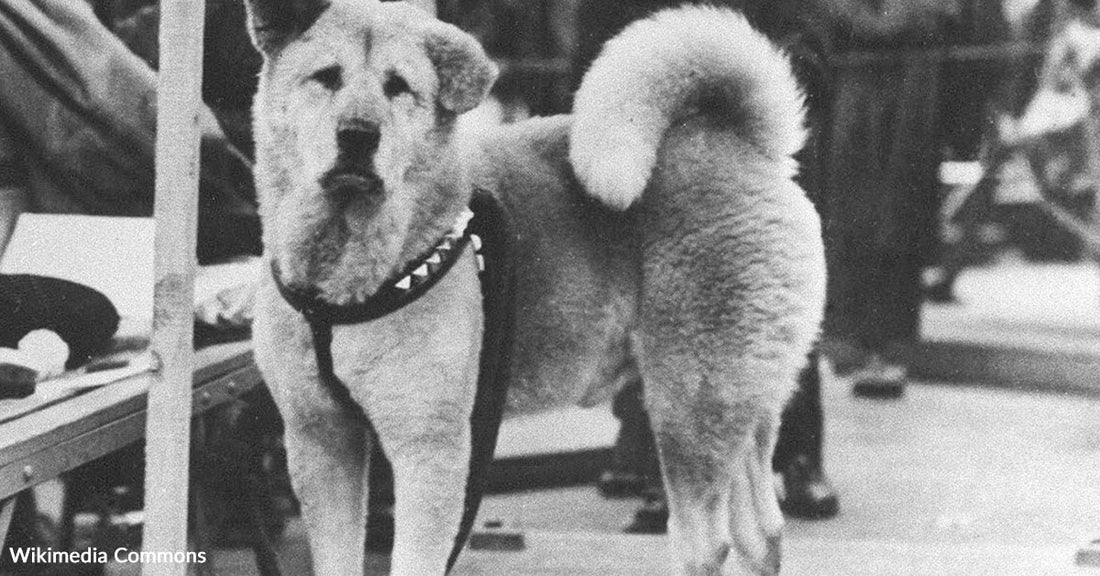
The story of Hachikō, the faithful dog of Shibuya Station, is one of those rare true tales that feels like a legend. It blends quiet devotion, everyday routine, and heartbreaking loss into a narrative that has resonated for a century. Japan marked the hundredth anniversary of Hachikō’s birth in 2023, and visitors still gather by his bronze statue at Shibuya, now one of Tokyo’s busiest crossroads, drawn to a simple story of loyalty that refuses to fade. For anyone exploring Japanese culture or searching for inspiring stories about dogs, Hachikō’s journey from rural Akita to the heart of Tokyo is a moving place to start.
Hachikō began life far from the neon lights of the city. He was born in November 1923 in Ōdate, Akita Prefecture, around 600 kilometers from Shibuya. One of a litter of Akita-inu puppies belonging to a farmer named Saitō Yoshikazu, he was part of a breed that Japan has officially recognized as a “natural monument.” Akita-inu are large dogs with a calm demeanor and thick, fluffy coats, admired not only for their beauty but also for their strong loyalty to their human companions. According to historical accounts, the breed developed in the 1630s by crossing Matagi hunting dogs with local dogs in order to create animals skilled at fighting, though in modern times they are celebrated more for their companionship than for their old working roles.

Around the same period that Hachikō was born, Ueno Hidesaburō, a professor in the Department of Agriculture at Tokyo Imperial University, was searching for a purebred Japanese dog. One of his students was working in Akita, learned of the farmer’s litter, and acquired the puppy on Ueno’s behalf. The journey from Akita to Tokyo was long and harsh. On a snowy day in January 1924, the 50-day-old puppy traveled for about 20 hours by train, wrapped in a rice bag to protect him from the cold, before arriving at Ueno Station in Tokyo and then being taken to Ueno’s home near Shibuya Station.
From the start, Professor Ueno cherished the frail little dog. He and his common-law wife Yae treated the puppy with warmth and affection, allowing him to sleep under Ueno’s bed and even share mealtimes. The professor named him Hachi, after the character 八, meaning “eight,” because the way the pup stood with his forelegs suggested that shape. The affectionate name Hachikō, by which he is now famous worldwide, grew from that simple choice.
Under their careful attention, Hachi grew from a delicate puppy into a sturdy Akita. He began accompanying Ueno on his daily commute, walking with him as far as Shibuya Station. In the evenings, the dog would appear again at the station, waiting for his master to step off the train. That gentle ritual of parting in the morning and reunion at night became the rhythm of their days together, the kind of small, repeated act that seems unremarkable until it is broken.
The break came abruptly. In May 1925, only about 16 months after Hachi joined the household, Ueno left for work as usual, with Hachi at his side until they reached the station. Later that day, during a faculty meeting, the professor suffered a cerebral hemorrhage and died at the age of 53. Hachi waited at Shibuya Station that evening, but his beloved owner never returned. He eventually went back to the house and huddled close to the clothes Ueno had worn that day, refusing food for three days and growing visibly despondent, as if sensing that something was deeply wrong.
The household itself did not remain intact for long. Because Yae was Ueno’s common-law wife, she was unable to inherit their Shibuya home and had to move into a smaller, rented residence. Hachi was taken in by an acquaintance who owned a kimono shop in Nihonbashi, some distance away. Even from there, he tried at times to make his way back to Shibuya Station, around eight kilometers from his new lodgings. He was later moved again, living for a time with relatives in Asakusa and then with Yae in Setagaya. Yet no matter where he stayed, his drive to reach Shibuya did not wane.
Eventually, Ueno’s former gardener, Kobayashi Kikuzaburō, who lived near the professor’s old home, heard about Hachi’s repeated attempts to return and took the dog in. Under Kobayashi’s care, Hachi could once again walk to Shibuya Station, which he began to do every morning and evening. Through rain, snow, and oppressive summer heat, he stood outside the ticket gates, watching the passengers come and go, as if patiently expecting Ueno to step out of the crowd one more time. He kept this routine not for weeks or months, but for years.
Hachikō’s constancy gradually attracted attention. Saitō Hirokichi, founder of the Japanese Dog Preservation Society, was especially moved and wrote an article in 1932 in a newspaper that would become today’s Asahi Shimbun. His account described how the dog had been appearing at the station for seven years after his owner’s death, still waiting for a master who could never return. As the story spread through print media and radio, people across Japan and abroad came to know the dog of Shibuya. Locals and station workers began to look out for him, offering care as he aged and grew weary.
Public affection eventually turned into a desire to honor Hachikō in a more lasting way. In 1934, volunteers raised funds to create a bronze statue outside Shibuya Station, and a 162 centimeter statue of the dog was mounted on a 180 centimeter pedestal at the station entrance. Remarkably, Hachikō himself was present at the unveiling ceremony on April 21. The moment joined the living dog with the image that would outlast him, fixing his story into the city’s landscape.
Not long after, in March 1935, Hachikō died at the age of 13, which is often compared to about 90 in human years. He had developed an infection caused by parasitic worms and had steadily weakened. Even so, he continued his station visits nearly until the end, waiting for almost a decade in vain for his master. A funeral for Hachikō was held on March 12, and his remains were laid to rest alongside Professor Ueno’s grave in Aoyama Cemetery. Many people, from children to older adults, came to pay their respects, including Yae and the staff of Shibuya Station. His pelt was preserved and mounted, and it can still be seen at the National Science Museum of Japan in Ueno. At Aoyama Cemetery, Hachikō’s gravestone stands beside that of the professor he loved so much.
The original bronze statue did not survive World War II. In October 1944, it was taken and recycled as part of the war effort, like many other metal objects in Japan at the time. After the war ended, however, public affection for Hachikō brought the statue back. It was rebuilt three years later, and the new Hachikō statue outside Shibuya Station has since become one of the most popular meeting spots in Tokyo. The phrase “Let’s meet at Hachikō” is now woven into the everyday life of the city.
Hachikō’s story was already traveling beyond Japan before the war. In 1937, American educator and disability rights advocate Helen Keller visited the statue in Shibuya. She was so taken with the Akita-inu that she was given one that same year and another in 1939 after the first dog passed away. Decades later, Hachikō’s tale inspired film adaptations, including Kaneto Shindō’s 1987 Japanese movie “The Story of Hachikō” and the 2009 American film “Hachi: A Dog’s Tale” starring Richard Gere, who has said the script moved him to tears. These works helped carry the story of the Shibuya dog and his unwavering wait to new audiences around the world.
Reflecting on Hachikō’s behavior, Saitō Hirokichi offered a perspective that feels both modest and profound. He cautioned against interpreting the dog’s years at Shibuya Station purely in human terms, as an example of honorable duty or obligation. In his view, Hachikō’s actions came from “pure affection” for the master who had treated him kindly, an expression of what he described as dogs’ “unconditional and absolute love.” That framing keeps the story grounded not in heroic myth, but in the everyday bond that can form between humans and animals.
Today, Shibuya has transformed into a dense landscape of high-rise buildings, massive digital screens, and heavy pedestrian traffic. Yet in the middle of this constant motion, the bronze Hachikō sits quietly near the station, tail curled, gaze gentle, still “waiting” in a sense for visitors who come to see him. The tale that began in the snows of Akita, passed through the simple routine of a professor’s commute, and endured a decade of patient watching at a station gate continues to touch people who stop, even briefly, to remember what loyalty can look like in its most unadorned form. Read more at nippon.com