
National Animal Shelter & Rescue Appreciation Week Support A Shelter Today!
Jets WR Adonai Mitchell Shares the Diabetes Diagnosis That Made Him Fear Losing Football
Guest Contributor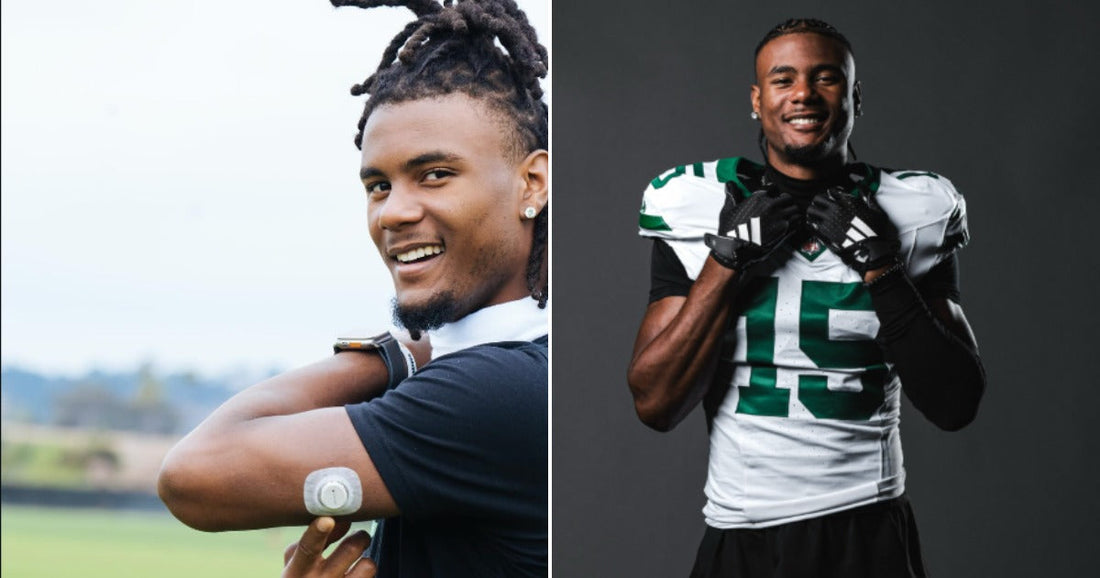
The question came in a hospital room when Adonai (AD) Mitchell was just 16: “Can I still play football?” At an age when most teenagers are simply trying to survive high school and maybe add a little muscle in the weight room, he was staring down a diagnosis he barely understood. Type 1 diabetes was suddenly part of his life, and all of the uncertainty around insulin, blood sugar, and long-term health rushed in at once. Yet in that moment, the future New York Jets wide receiver focused on the one thing he knew best. As the doctor explained that, yes, he could keep playing if he learned to manage his condition, the wide receiver felt a burden lift from his shoulders. That quiet exchange would frame everything that came after, including his journey to the NFL and his role today as an example for other athletes living with Type 1 diabetes.
Before that day, Mitchell was doing what many high school football players are told to do. He lifted, ran, and chased a target weight that felt like a badge of progress. Hovering around 166 pounds, he wanted to crack 170. Instead, his body started betraying him in ways he could not explain. He was constantly thirsty, using the bathroom all the time, and watching himself shrink in the mirror. When he finally stepped on a scale and saw 140 staring back at him, the number did not make sense. Teammates noticed, too, and they reacted in the way teenagers often do. They teased him for getting so thin without understanding what was actually happening to his body.

Instagram/mocitymitch
It took a frightening reading on a glucose meter to bring the truth into focus. When a doctor tested his blood sugar, the device did not even show a number. It simply flashed “high,” an alarm that sent him to the hospital and led to the official diagnosis of Type 1 diabetes. For Mitchell and those around him, it was a crash course in a disease that is frequently misunderstood. He did not come from a family where Type 1 diabetes was part of daily life, and he had little frame of reference for what his future would look like beyond that single, urgent question about football.
Part of what makes his story resonate is how it pushes against the casual stereotypes surrounding diabetes. Jokes about “having the sugar” or losing a foot still pop up in comedy, social media, and everyday conversation. The condition is often treated as a punchline or reduced to a comment about dessert choices. Those shortcuts also tend to blur the crucial difference between Type 1 and Type 2 diabetes. With Type 1, the immune system attacks the cells that produce insulin. It is not caused by eating too much sugar or skipping workouts, and people with Type 1 need insulin to stay alive. Type 2 diabetes is different, involving resistance to insulin the body still makes, influenced by weight and activity but also age, genetics, and other factors that are not fully under a person’s control.

Instagram/mocitymitch
By the time Mitchell was diagnosed, millions of Americans were living with diabetes. The Centers for Disease Control and Prevention has estimated that more than 40 million people in the United States have diagnosed or undiagnosed diabetes, with roughly 2.1 million living with Type 1. Those numbers are large, yet the experience can still feel isolating, especially to a teenager trying to understand why his body suddenly feels foreign. I found this detail striking: Mitchell’s early weeks after diagnosis were as much about educating friends and teammates as they were about learning his own treatment routine. He had to explain the weight loss, the constant blood sugar checks, and the insulin injections, all while adjusting his identity as an athlete who now carried a chronic condition.
Like many young players, Mitchell looked outward for proof that his dreams were still possible. Film study is part of football culture, and athletes love to model their craft after the greats. Just as a receiver might watch how Jerry Rice releases off the line or how Randy Moss tracks a deep ball, Mitchell went searching for professional athletes who also lived with diabetes. At first, the list felt short. He found examples such as NFL quarterback Jay Cutler and defensive back Patrick Peterson, who had spoken publicly about their diagnoses. Today, the landscape looks a bit different. A younger athlete can see Mark Andrews excelling at tight end for the Baltimore Ravens while managing Type 1, or watch professional soccer player Jordan Morris thrive after being diagnosed at age 9. Mitchell is now part of that expanding group that quietly changes what seems attainable for kids facing the same news he heard at 16.

Instagram/mocitymitch
It is one thing to navigate diabetes as a high school or college athlete. It is another to have the condition pulled into the unforgiving spotlight of the NFL draft process. After winning two national championships at Georgia, transferring to Texas, and proving that he could perform at an elite level, Mitchell’s talent was not in question. Instead, anonymous pre-draft scouting reports raised concerns that blended his health condition with subjective judgments about his personality. One evaluator claimed his behavior shifted with his blood sugar, suggesting he could become “rude” or “abrasive” when his levels were off. Other whispers suggested he did not take his diabetes seriously enough.
Those criticisms spread quickly, as they tend to do in the months leading up to the draft. Former teammates spoke up in his defense, and when the Indianapolis Colts selected him 52nd overall, general manager Chris Ballard publicly condemned anonymous attacks on young prospects’ character. Mitchell himself said he was not entirely sure what the comments were really about, pointing out that the sources never put their names behind the claims. At the same time, he did not deny that blood sugar can influence how a person feels. Like many people with chronic illnesses, he walked a careful line between acknowledging the real challenges and refusing to let the disease be used as a simplistic explanation for his entire personality.
That distinction matters. Diabetes can affect energy, focus, and mood, particularly when glucose levels swing high or low. Yet to reduce a person’s character or work ethic to their medical condition ignores the complexity of living with it day to day. For Mitchell, managing Type 1 did not stop being a full-time responsibility the moment he stepped onto a college or NFL field. It required a constant blend of awareness, preparation, and support behind the scenes.
Technology has played an important role in that process, especially as he moved into high-level college football. While at Georgia, Mitchell began using a Dexcom G7 continuous glucose monitor, a device that allowed him to see his glucose levels in real time and track where they were trending without repeated finger sticks. His reaction was almost nostalgic frustration. Where had this been when he was first diagnosed and trying to understand his body’s signals using older methods? Tools like continuous monitoring became crucial as practices intensified, training demands shifted, and recovery from injury introduced new variables that affected blood sugar.
Nutritionists, medical staff, and coaching personnel also became an integral part of his routine. Mitchell has spoken about relying heavily on that team while dealing with a finger injury, balancing healing with blood sugar management and medications. For many athletes with diabetes, these relationships are not optional extras. They form the infrastructure that makes elite performance possible while keeping long-term health at the forefront. This is where his partnership with Dexcom U fits in less as a standard endorsement and more as a full-circle moment. The program features dozens of college athletes in various sports who compete while living with diabetes, giving younger kids relatable role models who reflect their own reality.
Mitchell understands the power of that visibility because he remembers when those role models were hard to find. Years ago, a teenager sat in a hospital room wondering if a diagnosis meant the end of football. Today, a young athlete searching the internet after hearing the words “Type 1 diabetes” can find highlight reels of a Jets wide receiver making plays on Sundays while openly sharing how he manages his condition. Alongside other high-profile athletes who live with diabetes, Mitchell’s story quietly broadens what is possible. It does not erase the challenges or the constant work of monitoring blood sugar, but it shifts the narrative from limitation to adaptation. For the next kid in that hospital room, the question “Can I still play?” comes with more living, breathing answers than ever before.
Read more at https://sports.yahoo.com/articles/jets-wr-ad-mitchell-opens-181435409.html