
🚨Urgent: Missile Strikes Shelter in Ukraine! Rush Emergency Aid!
Rescuers Hear Tiny Kitten Crying Underground for Three Days Before They Can Reach Him
Guest Contributor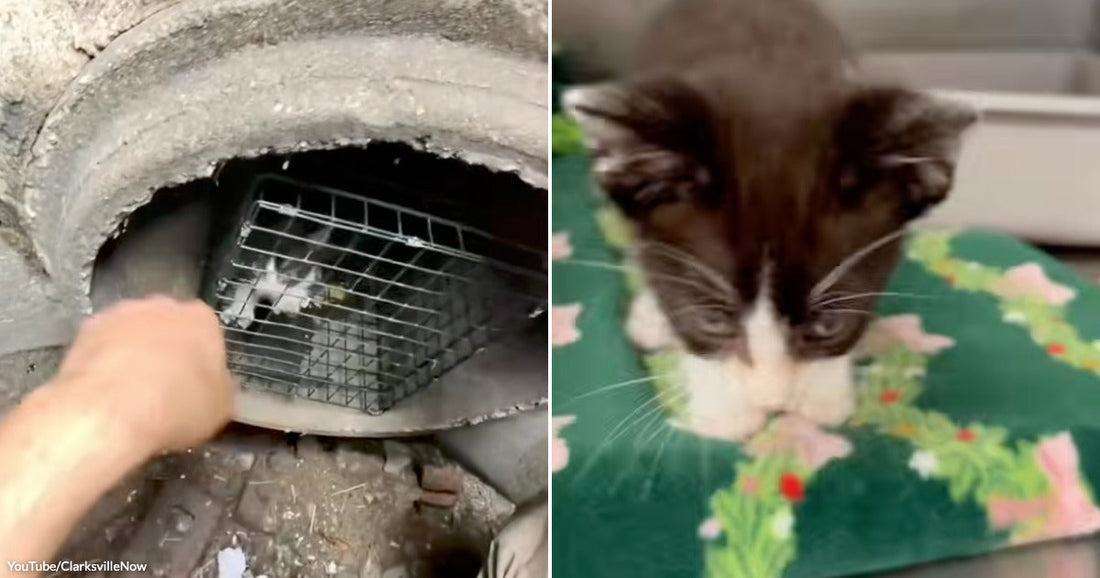
A small kitten in Clarksville, Tennessee recently turned a storm drain into his temporary home, setting off a tense three-day rescue that captured the attention of local animal welfare workers and first responders. The kitten trapped in a storm drain not only survived his ordeal but is now safe, recovering in a foster home, and waiting for his chance at adoption. The story offers a quiet but powerful reminder of how persistence, coordination, and compassion can change the course of one tiny life.
According to Montgomery County Animal Care and Control, the call for help came on the morning of June 5. Around 9:55 a.m., Clarksville Fire Rescue contacted the agency after a kitten was heard crying somewhere within a drainage system near Cumberland Drive. The location alone made the situation tricky. Storm drains and underground pipes are often dark, confined, and unsafe for people to enter, especially when the full layout is unclear. The kitten could be heard, but not seen, and that created both urgency and limits on what rescuers could attempt.

An officer from MCACC responded to the scene and confirmed that there was indeed a kitten in distress. The officer could hear the cries echoing from inside the pipe, but the kitten remained out of sight and out of reach. With no safe way to climb inside or reach directly into the drainage system, the officer turned to a familiar tool in difficult animal rescues: a humane trap. The trap was carefully set and checked repeatedly throughout the day, but as evening approached, the kitten still had not ventured inside.
This pattern of hope, waiting, and cautious disappointment set the tone for the following days. On June 6, Clarksville Fire Rescue returned to assist with the effort. This time, their focus was on accessing more of the drainage system by lifting the storm drain cover. Once again, responders could hear the kitten somewhere in the network of pipes. His cries confirmed he was still alive, but he continued to remain hidden. The drainage system provided many narrow places to shelter, and the kitten’s position kept shifting out of reach.

YouTube/ClarksvilleNow
Rescuers responded by setting another humane trap and carefully monitoring it. Safety, however, remained a priority. Leaving equipment in an open storm drain overnight was not an option. Each evening, they removed the trap and replaced the heavy drain cover, then returned the next day to try again. The process demanded what MCACC spokesperson Christy Bollinger-Bastin later described as “several days of patience, repeated checks and coordination” between MCACC and Clarksville Fire Rescue.
I found this detail striking because it emphasizes how animal rescue is often less about single dramatic moments and more about consistent, methodical care. Rather than rushing into risky tactics, the teams involved focused on repeated observation and safe strategies that protected both the responders and the animal they hoped to help.
After two days of effort and uncertainty, the turning point finally came on June 7. Around 6 p.m., an MCACC officer returned to check the storm drain yet again. This time, there was a different sound and a long-awaited sight. The kitten had finally gone into the trap. Safely contained, he could be lifted from the underground space where he had spent three long days and brought out into the open air.

YouTube/ClarksvilleNow
The rescued kitten was transported to the MCACC shelter, where staff could properly assess his condition. After such a prolonged ordeal in a storm drain, there was reasonable concern that he might be dehydrated, injured, or ill. According to Bollinger-Bastin, however, the outcome was better than many might expect. The kitten was described as being in good shape, with no major injuries or serious health concerns. Images show him resting on a blanket, a far gentler environment than the cold, hard surfaces of a drainage pipe.
At that point, another question came into focus. Was there an owner searching for this kitten, or had he been on his own all along? With no owner coming forward, MCACC followed standard procedures and processed him as a stray. For stray kittens rescued from dangerous situations, the next steps are crucial. They need safety, stable care, and the chance to grow strong enough for adoption.
Staff within the agency stepped up to ensure that happened. The kitten was placed in a foster home with an MCACC staff member, giving him around-the-clock care that a shelter environment alone cannot always provide. Foster care can be especially important for young cats who have experienced stress or trauma. It allows them to adjust to indoor life, build trust with humans, and develop healthy routines in a calmer space.
With a new life comes a new name. The kitten is now known as Rascal, a fitting choice for a tiny survivor who managed to hide deep in a drainage system for days while people searched and worried above. MCACC has shared that Rascal will be eligible for adoption once he grows a bit more, likely in a few weeks. His journey from a storm drain to a foster home illustrates how a stray animal can move from a dangerous situation to a hopeful future through coordinated community response.
The story of Rascal’s rescue highlights several meaningful themes for anyone who cares about animal welfare. First, it underscores the importance of collaboration. Clarksville Fire Rescue and Montgomery County Animal Care and Control each brought different skills and responsibilities to the situation. Fire rescue crews assisted with physical access to the storm drain infrastructure, while animal control officers handled the safe capture and care of the kitten. Without both agencies working together, the outcome might have been very different.
Second, the rescue demonstrates the value of humane traps and patient monitoring in situations where direct contact is impossible or unsafe. Rather than attempting to reach blindly into pipes or taking risks in confined spaces, responders relied on tools designed to bring animals out on their own terms. This method might take longer, as Rascal’s three-day storm drain rescue shows, but it can significantly reduce dangers for everyone involved.
Third, the story draws attention to what happens after an animal is saved. Rescue is only the beginning of a longer process that includes health checks, foster care, and eventual adoption. In Rascal’s case, being processed as a stray ensures he will go through a structured path to find a permanent home. The use of foster homes, particularly with trained staff, helps young animals transition from survival mode to a more relaxed, socialized life. For potential adopters, knowing that a kitten like Rascal has spent time in a foster environment can be reassuring, as it suggests he has had consistent care and observation.
Finally, Rascal’s experience invites reflection on the countless small acts of service that often go unseen. The officers and firefighters who returned day after day to check a storm drain and reset a trap did not know how the story would end. They only knew that a frightened animal was crying somewhere below them and that it was worth trying, again and again, to bring him to safety. Their success turned a hidden crisis beneath a Clarksville street into a hopeful adoption story in the making.
For now, Rascal is resting, growing, and getting ready for the next chapter of his life. His story is a reminder that even routine infrastructure like a storm drain can suddenly become the center of a community effort, and that the careful work of local agencies can transform a moment of distress into a second chance. When he is finally ready for adoption, his future family will not just be welcoming a kitten. They will be welcoming a survivor whose life was changed by patience, teamwork, and the simple insistence that one small voice crying from below was worth hearing and helping.