
🚨Urgent: Rush Aid to People & Pets in Nepal's Devastating Floods! Help Now!
Tiny Therapy Horse Steals Hearts While Bringing Comfort To Children In Pain
Guest Contributor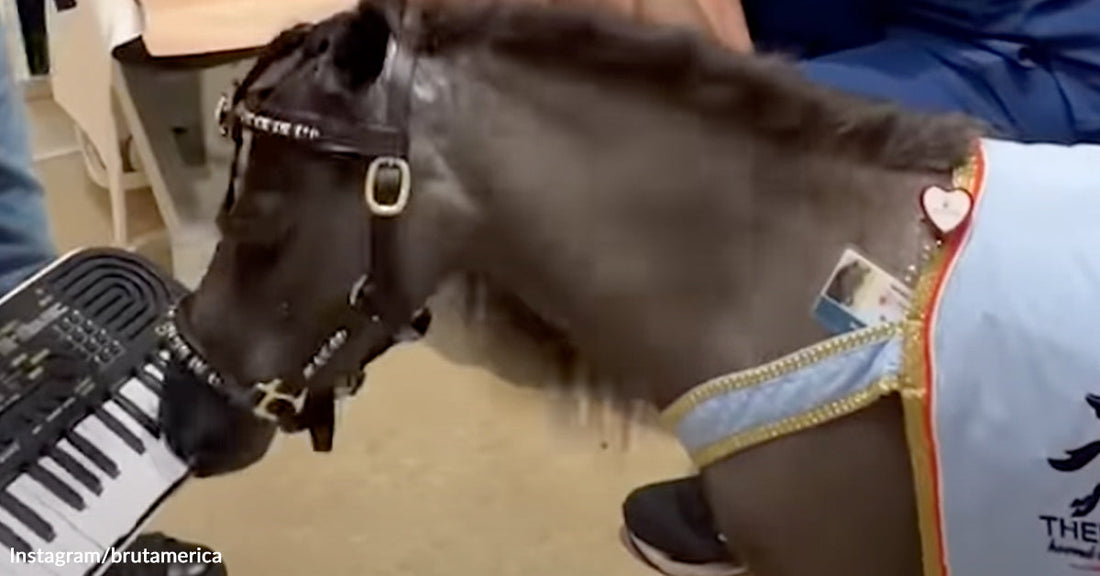
In a world where animal videos race across social media every day, it takes something truly unusual to stand out. A keyboard-playing therapy mini horse named Black Pearl manages to do exactly that. Her story is not only charming and a little surreal, it also highlights the very real power of animal-assisted therapy and the quiet dedication behind Mini Therapy Horses, a small nonprofit based in California. For anyone curious about therapy horses, hospital animal visits, or simply looking for a refreshing example of kindness in action, Black Pearl’s work is worth a closer look.
Black Pearl, often called Pearl by those who know her, is a 17-year-old miniature horse with a unique talent. In a recent viral video from Shriners Children’s Southern California, she stands at an electric keyboard in her official therapy vest, running her lips across the keys and producing a cascade of bright notes. A child is waking up from anesthesia as Pearl “plays,” and the moment is both whimsical and gentle. The video was shared widely online, even reposted by DJ and producer Diplo, who joked about working on his next summer anthem. Behind the viral clip, though, is years of careful training, thoughtful partnership, and a clear purpose.

Mini Therapy Horses was founded by Victoria Nodiff Netanel in the Santa Monica Mountains. After years in competitive dressage, she missed the presence of horses in her everyday life. She acquired Pearl simply as a companion so that horses could remain part of her routine while she worked. With extensive horse experience already, she found herself gradually training Pearl in new behaviors. Pearl was eager to learn and responded so well that trick training and more complex tasks became a natural progression rather than a formal plan. As reported, Nodiff Netanel described how she never initially imagined teaching Pearl so much, yet the little horse’s enthusiasm and responsiveness kept opening new possibilities.
At some point, that informal training turned into a larger idea. Nodiff Netanel recalls having a “light bulb moment” when she wondered whether she could combine her lifelong love of horses with a desire to help other people. At that time, she knew little about animal therapy, hospital procedures, or what would be required to bring an animal safely and professionally into medical settings. So she moved slowly, taking one careful step after another. That incremental approach would eventually shape Mini Therapy Horses into an organization that now visits hospitals, schools, and first responders several days a week.
The earliest and longest-standing partnership for Mini Therapy Horses is with the Veterans Affairs Greater Los Angeles Health Care system. Gaining access to that first hospital was neither quick nor easy. Nodiff Netanel had to demonstrate both her own training and Pearl’s readiness for what can be an intense, unpredictable environment. After that lengthy process, she began visiting patients, and nearly 17 years later, she and one of her horses still stop by the VA every Monday. Their rounds include the psychiatric unit, intensive care, and the rehabilitation clinic, spaces where patients may face serious physical and emotional challenges.
Staff at the VA report that the miniature horses are cherished by veterans. According to Dr. Blessen Eapen, chief of physical medicine and rehabilitation service, the horses help alleviate stress, increase alertness, and encourage patients to participate more fully in their sessions. They also become a memorable bright spot in the hospital routine. It is striking how something as small as a miniature horse, calmly walking down a corridor, can change the energy of a room and invite people into conversation who might otherwise remain withdrawn.
Today, Mini Therapy Horses operates as a very active, volunteer-led nonprofit. The organization now includes a team of nine mares, with Pearl as one of the most recognizable faces. They visit multiple locations in the Los Angeles area, including Shriners Children’s Southern California, UCLA, Ronald McDonald Houses, and Cedars-Sinai Medical Center. During the school year they spend time with both grade school and college students. They also visit Los Angeles Police Department 911 responders, bringing small moments of comfort to people working in incredibly high-stress roles.
One of the most powerful aspects of animal-assisted therapy is its ability to shift self-perception. Nodiff Netanel describes visits with children in hospitals where staff encourage young patients by saying, “You’re a cowboy” or “You’re a cowgirl” as they walk their own therapy horse. For kids who might be feeling self-conscious, awkward, or overwhelmed by their medical situation, that change in framing can be significant. Suddenly they are not just a patient tethered to equipment. They are someone leading a horse, participating in an interaction, and being seen in a different light. She notes that this simple act can transform a child’s mental state in a positive way.
The horses’ involvement often goes beyond emotional support. At Shriners, for example, the horses can be part of physical therapy sessions. Pearl and her herd mates are trained for activities that align with a child’s therapeutic goals. One exercise involves a horse gently kicking a ball back and forth. The child then kicks it in return, possibly with a prosthetic limb or with the remaining part of a limb before they receive a prosthetic. In that scenario, a routine physical therapy task becomes a shared game with an animal partner. The focus shifts from effort and discomfort to play and connection, which can make the hard work feel more achievable.
Behind every calm visit is substantial preparation. Each miniature horse is carefully selected soon after weaning. Before deciding to purchase, Nodiff Netanel spends time with the young horse to get a sense of temperament. Not every animal is suited for therapy work, and the selection process is critical. Once a horse joins the team, training begins slowly. Like children, some horses pick up new skills quickly while others need more time. All of them are met with patience and affection so they become comfortable with frequent touch and handling. They are gradually exposed to loud or surprising stimuli, such as the sound of rocks shaken in a cup, so that alarms, busy hallways, or unfamiliar noises will not easily startle them during visits.
Mini Therapy Horses runs entirely on volunteer energy. No one, including Nodiff Netanel, receives a salary for their work. Instead, a core group of about 15 volunteers helps care for the horses and support visits. That level of commitment over nearly two decades reveals how meaningful this mission has become to those involved. Even after all these years, Nodiff Netanel says each visit still feels special. It is not a routine to be rushed through but an ongoing series of quiet, individual moments where a small horse and a person in need connect in a hallway, a therapy room, or by a hospital bed.
I found it especially striking that despite the viral fame of Black Pearl’s keyboard performance, the heart of the story lives in those everyday, less visible encounters. Viral animal videos can be entertaining, but in this case they hint at something deeper: a carefully nurtured bond between humans and animals, transformed into a consistent source of comfort for people who may be facing some of the hardest days of their lives. In that sense, Black Pearl is more than a social media star. She is a bridge between lightness and difficulty, between play and healing, between a child’s uncertainty and a moment of confidence holding a lead rope.