
💜 Thanksgiving Food Drive for Shelter Pets Help Us Feed 1 Million Shelter Pets!
Tahlequah, the Orca Who Carried Her Lost Calf for 17 Days, Welcomes a Healthy Baby Boy
Guest Contributor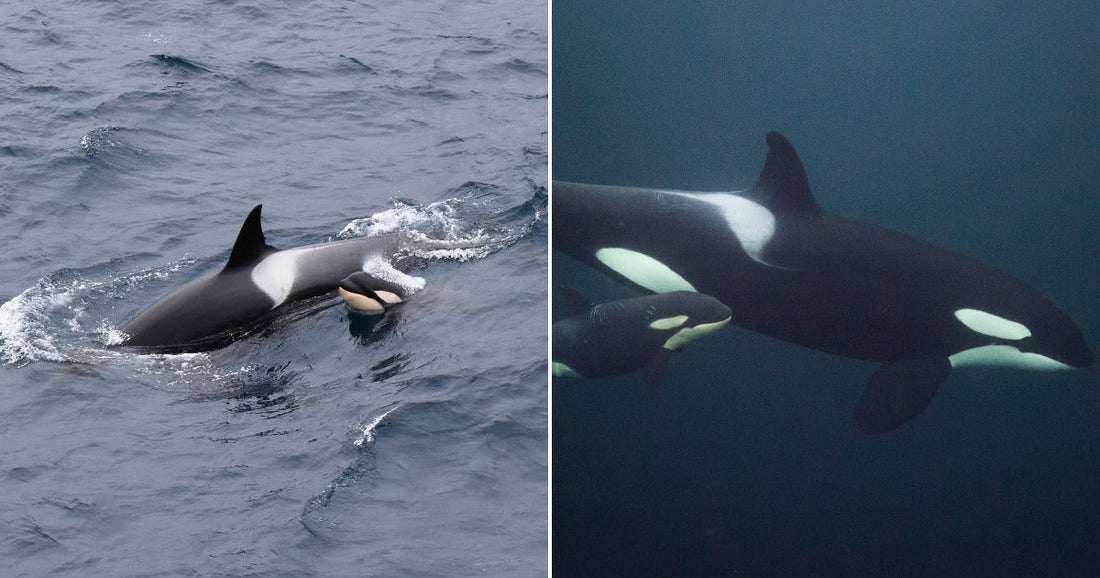
A rare bright spot appeared this week for the endangered Southern Resident killer whales in Washington State. Researchers from the Center for Whale Research confirmed that J Pod, one of the three family groups in this fragile population, has a new member: a newborn male orca calf. For people who follow the Southern Residents closely, any news of a new baby orca in J Pod feels both hopeful and bittersweet, a reminder of resilience unfolding within a deeply vulnerable community of whales.
The calf has been designated J65, following the naming convention used to track individual Southern Resident killer whales. According to the Center for Whale Research, he was first seen on Monday swimming very close to his mother, J35, also known as Tahlequah. Based on his appearance and recent observations of J35, researchers estimate that J65 is less than a week old. That tiny window of time captures an especially critical and delicate stage in the life of a young orca.

Researchers encountered the pair again the following day and used drone footage to confirm that the new calf is male. The footage and direct observations showed J65 staying close to J35, surfacing regularly, and moving with the coordinated rhythm that indicates strong early swimming behavior. The team also observed him socializing and nursing, which are encouraging signs that he is bonding with his mother and integrating into the pod’s daily activity.
J35 herself is one of the most widely known members of the Southern Residents. She gained international attention in 2018 after carrying the body of her deceased calf for 17 days and over hundreds of miles, an extended period of visible grief that touched people around the world. That heartbreaking vigil highlighted not only the emotional depth of orcas but also the precarious situation of an endangered killer whale population struggling with limited food, vessel noise, and other pressures.

In the years since, J35 has continued to play a vital role in her pod. The Center for Whale Research notes that J65 is the sixth documented calf for J35. Her first documented surviving calf, J47, was born in 2010. She later gave birth to another son, J57, in 2020. More recently, in 2024, she had a daughter, J61, who did not survive. Against that history of both survival and loss, the arrival of J65 carries a weight of cautious optimism for those tracking the fate of these endangered whales.
Researchers say that so far, the new baby orca appears to be healthy. Dr. Michael Weiss, research director at the Center for Whale Research, reported that the team saw no immediate indication of health issues in the calf. Observations of nursing behavior suggest that J35 is able to provide for him at this early stage, which is critical for his growth and immune system development. Healthy nursing and close contact with his mother give the calf his best chance to learn, gain strength, and navigate the early challenges of life in the Salish Sea.

At the same time, the scientists involved are careful not to overstate the good news. As Dr. Weiss explained, early life is particularly challenging for orcas, and only about half of them are expected to survive their first year. That sobering statistic underscores why each new birth is met with both joy and concern. For an endangered Southern Resident killer whale calf, the first year is a gauntlet of biological vulnerability, environmental pressure, and the constant need for abundant prey.
The research team plans to continue monitoring J65 and his mother whenever conditions allow. Returning encounters can help scientists determine how the calf is growing, whether he continues to nurse successfully, and how he fits into the larger social fabric of J Pod. Regular sightings can also indicate whether there are any emerging health issues that might warrant closer attention. Long term monitoring has been one of the most important tools in understanding the status and needs of the Southern Resident population.
This new calf arrives in a context of long running concern for the Southern Resident killer whales, a distinct population of orcas that spends much of its time in the Salish Sea region around Washington and British Columbia. Their numbers have declined over the decades, and they are now formally listed as endangered. Scientists have identified multiple threats, including reduced availability of their primary prey, vessel disturbance, and environmental contaminants. Against that backdrop, each new calf is more than just an individual life; it becomes a symbol of the population’s ongoing fight for survival.
The story of J35 and J65 also illustrates how closely people follow the lives of these whales. J35’s visible grief in 2018 resonated widely, and many have continued to watch her journey, hoping for signs of recovery and renewal. The birth of a new male calf to the same mother who once carried her lost baby for so long has a poignancy that is hard to ignore. It is a reminder of how intertwined loss and hope can be in conservation stories, especially for marine mammals whose lives are so publicly documented.
From a scientific perspective, every calf that survives its first year adds to the genetic and social strength of the pod. In a population as small and vulnerable as the Southern Residents, each surviving calf can help stabilize numbers and maintain family structures that are crucial to orca culture. J35’s role as an experienced mother may be especially important here, since older females often contribute significant knowledge about feeding grounds, migration routes, and social behavior.
I found this detail striking: researchers highlighted that half of young orcas do not make it past their first year, yet they still frame the arrival of J65 as a meaningful step forward. That blend of realism and hope captures the tone surrounding this latest development. No one is declaring a turnaround for the Southern Resident killer whales, but there is a recognition that survival happens one calf at a time, supported by careful monitoring, research, and long term conservation efforts.
For now, J65’s story is only beginning. He is a tiny new member of J Pod, learning to navigate the waters alongside his mother, siblings, and extended family. His presence offers a moment of celebration for researchers, advocates, and anyone who cares about the future of endangered Southern Resident killer whales. As the Center for Whale Research and its colleagues continue to observe J65, their work will help the public stay connected to his progress and to the broader challenges facing these remarkable animals.