
🚨Urgent: Missile Strikes Shelter in Ukraine! Rush Emergency Aid!
Turtle Scarred By Plastic Rings Keeps Defying The Odds Three Decades Later
Guest Contributor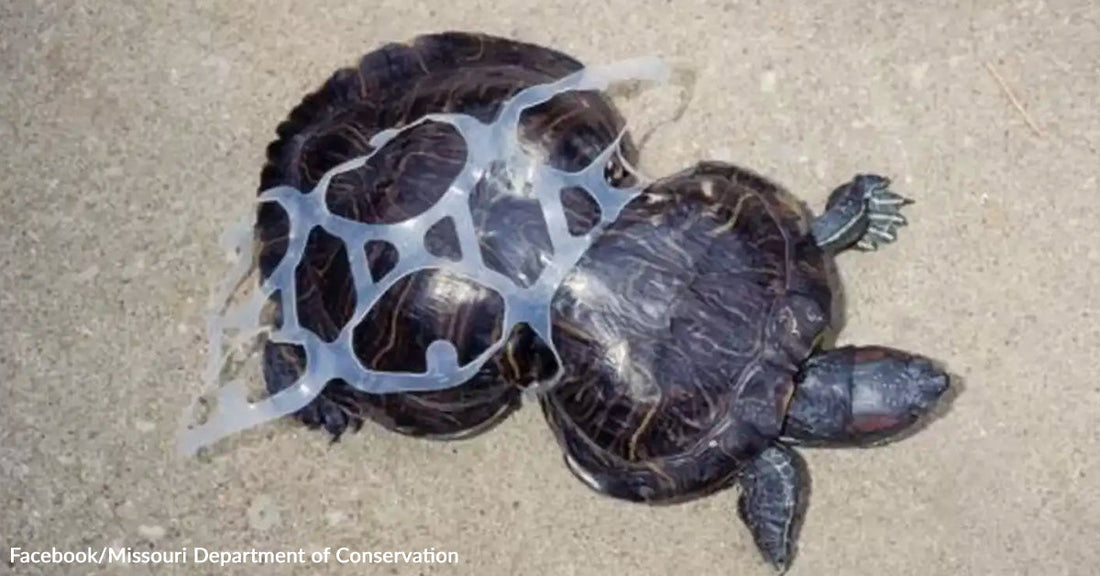
In the early 1980s, a tiny red-eared slider turtle hatched somewhere in the wilds of Missouri, facing the same uncertain odds of survival that every young turtle does. For this turtle, later named Peanut, those odds became even more daunting when a piece of human carelessness entered her life. A discarded plastic six-pack ring tightened around her small shell and never let go. As she grew, the ring did not break or stretch. Instead, it cinched her body into an hourglass shape, a visible reminder of how something as ordinary as litter can become life altering for wildlife.
Peanut’s story has captured attention for decades partly because it is so visual. People immediately understand what “a turtle deformed by plastic rings” looks like, and that image can be hard to forget. The Missouri Department of Conservation eventually took Peanut in, and she has become a living example of the dangers of plastic pollution. The phrase “litter-fighting superhero,” used by her caretakers, is more than a catchy nickname. It reflects the way one animal’s survival has been transformed into a powerful educational tool.

When Peanut was young and still growing, the plastic ring acted as a rigid belt around the soft, developing shell. Her front and back end kept increasing in size, while the middle stayed compressed. Survival under those conditions was far from guaranteed. The original report notes that every day was a struggle for her, and life in the wild with such a severe deformity would have made long-term survival unlikely. Predators, difficulty moving, and simple exhaustion could all have ended her life much earlier.
Everything changed in 1993 when someone finally discovered her and cut away the ring. The source describes that moment as a turning point, though it also makes clear that the damage to her body could not be undone. Even with the plastic removed, Peanut’s shell and internal structure remained permanently misshapen. It was not clear whether she would be able to live a long life or whether the strain of her earlier years would catch up with her. The uncertainty around her health at that time makes her later milestones all the more remarkable.
Since her rescue, Peanut has lived under the care of the Missouri Department of Conservation instead of returning to the wild. The organization recognizes that her unique shape and story can foster understanding in a way statistics about pollution sometimes cannot. According to handler Amy Wilkinson, people see Peanut, hear what happened to her, and “they get it.” In those few words, there is a whole world of reaction: shock, concern, empathy, and a new awareness that a simple act like tossing away a six-pack ring can reverberate through the life of another creature.
Peanut’s role as an educator has taken many forms. The article notes that she is used in litter campaigns around the world, which means images of her distinctive shell and her story have traveled far beyond Missouri’s borders. When people encounter messaging about “a turtle cut free from six-pack rings,” they are often seeing Peanut as the example. That kind of storytelling can anchor abstract ideas like pollution and conservation in a single, relatable life. I found this detail striking because it highlights how one rescued animal can influence behavior on a much larger scale.
Her survival is also personally impressive. The recent celebration of Peanut’s 41st birthday marks a milestone that few would have predicted when she was found trapped in plastic decades ago. The Missouri Department of Conservation chose to honor her publicly, dubbing her a “litter-fighting superhero” and spotlighting the lesson she continues to share. That celebration reflects not just her age, but the continuity of her impact. She is no longer the young turtle whose shell was still forming around a piece of trash, yet the shape of her body still tells that story clearly.
For visitors who meet her now, Peanut is a living reminder that litter has long-term consequences. A discarded object can linger in the environment for years, intersect with wildlife in unexpected ways, and cause harm that persists even if the object is eventually removed. In her case, the plastic ring was cut away, yet the effects remain visible every time someone sees her swim or rest. The article underscores this message by quoting her caretakers, who write that she is “not a teenager anymore,” but that her “mighty message” endures.
There is something quietly hopeful about the way her life has unfolded. It does not erase the harm she suffered, and it does not change the fact that many animals harmed by plastic never receive help. Yet Peanut’s continuing health shows that rescue and long-term care can transform a narrow escape into a powerful educational story. Her journey from struggling wild turtle to ambassador for conservation gives people a tangible reason to think twice about how they dispose of everyday items like six-pack rings and other plastic packaging.
Peanut’s story, as presented by the Missouri Department of Conservation and reported in the article, offers a simple, accessible takeaway: small choices matter. Properly putting litter in its place can prevent needless suffering for animals that share our environment. Each time someone sees an image of Peanut’s hourglass-shaped shell or hears about the red-eared slider who survived plastic rings and is still unstoppable 30 years later, that message has another chance to sink in, shaping new habits and, ideally, sparing other animals from a similar fate.