
💜 Thanksgiving Food Drive for Shelter Pets Help Us Feed 1 Million Shelter Pets!
Video Of Men Nudging A Sleeping Monk Seal With Their Feet Sparks Outrage In Hawaii
Guest Contributor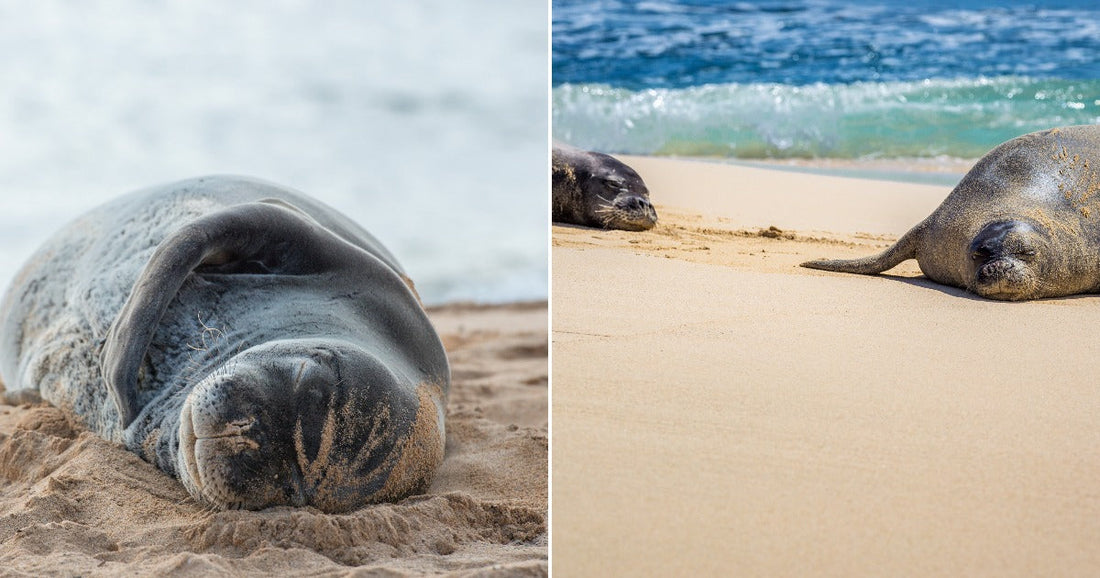
A short, unsettling video from West Oahu is once again drawing attention to how people treat one of Hawaii’s most endangered and protected marine animals. In the clip, filmed near what appears to be a beach in the Makaha area, a man walks up to a sleeping Hawaiian monk seal and taps it with his foot, behavior that viewers and advocates are describing as harassment of a monk seal and an example of a troubling pattern across the islands.
The video itself is simple but jarring. As reported by Hawaii News Now, it appears to show a man approaching the resting seal and making deliberate contact with his foot. The animal flinches in response to being disturbed. The person filming then seems to stretch a foot forward and touch the seal as well. Laughter can be heard in the background, giving the moment the tone of a casual joke rather than a serious encounter with a protected species. The clip was later shared on a popular social media page, where it quickly attracted attention and criticism.

Local authorities are still catching up with the online outrage. According to the reporting, the Honolulu Police Department confirmed that it had not received any formal report of the incident at the time of the story. Hawaii News Now also reached out to the state Department of Land and Natural Resources to see whether officials were aware of the footage. The department had not yet responded when the station’s report was published, leaving open questions about whether the video would trigger an official inquiry.
Reactions from animal advocates highlight why so many people found the video disturbing. Animal rights advocate Michelle Poppler described the laughter and apparent lightheartedness in the recording as making the interaction feel even worse. She characterized the behavior as disrespectful, careless, and mean. The comparison she drew was to bullying on a playground, a familiar image that underscores how an act that might seem small or quick can still be an expression of power at the expense of a more vulnerable being.

Poppler also focused on the role of local knowledge and responsibility. In her view, people in Hawaii, especially locals, should not be able to claim they simply did not know better. Public outreach, news coverage, and posted guidelines have repeatedly stressed that Hawaiian monk seals are protected marine mammals, and that approaching, touching, or harassing them can have serious consequences. According to the coverage, those consequences can include tens of thousands of dollars in fines and even potential prison time when someone is found to have violated state or federal protections.
The incident near Makaha does not stand alone. Instead, it has become the latest example in a string of confrontations involving monk seals and people around Hawaii. Hawaii News Now pointed to several other cases from recent months in which seals have been disturbed, intimidated, or directly harmed. Together, these episodes are shaping a broader public conversation about respect for wildlife in coastal spaces that humans and animals share.

One earlier case unfolded in Lahaina this past May, when a Washington State resident, identified as Igor Lytvynchuk, was filmed throwing a rock at a monk seal near the shoreline along Front Street. Witnesses reported that a couple had repeatedly approached a seal resting near the water before the rock was finally thrown. In that case, Lytvynchuk was arrested and later pleaded not guilty to two misdemeanor charges in federal court. According to the report, his trial was scheduled for January, making it a closely watched legal test of how far the law will go in penalizing such actions.
Another recent investigation began in August, when state authorities looked into reports that two men had hurled a rock at a monk seal on a beach near Diamond Head. Details in that case were still emerging, but it added to public unease about how often people are willing to get close to or provoke endangered wildlife for a moment of entertainment or attention. These cases tend to be amplified by social media, where short clips can travel quickly and spark strong reactions far beyond the original scene.
Social media also played a role in a widely discussed incident on Kauaʻi earlier this month. A post showed two women posing with a Hawaiian monk seal at Salt Pond Beach Park. The imagery was enough to trigger backlash online and led both state and federal authorities to begin looking into what had happened. Unlike the more overt act of rock throwing, this situation revolved around proximity and contact, but the response highlighted how any unnecessary interaction with monk seals can raise red flags when it appears to cross the line into disturbance or harassment.
Taken together, these stories reveal a pattern that troubles many residents and advocates. On one hand, there is relief that bystanders sometimes record and share problematic behavior, making it harder for such actions to go unnoticed. On the other hand, the fact that people are still walking up to monk seals, touching them, throwing objects, or posing closely with them shows that rules and educational campaigns have not fully taken hold. I found this detail striking because it suggests that awareness alone may not be enough without a shared commitment to enforcement and accountability.
Within this context, the Hawaiʻi Department of Land and Natural Resources has repeatedly urged the public to play an active role in protecting monk seals. The agency’s guidance emphasizes that witnesses should report any potential violation, and that documentation matters. Time, location, a description of what occurred, and any other specifics can all help investigators decide whether an incident rises to the level of legal action. While the video near Makaha had not yet resulted in an official report at the time of the news coverage, officials consistently encourage people not to assume someone else will step forward.
The story of the monk seal tapped with a foot in West Oahu resonates beyond a single beach or a single video clip. It reflects a larger tension in popular coastal areas where threatened animals rest, feed, or raise young close to where people gather. Hawaiian monk seals have become emblematic of this challenge, highly visible and deeply protected at the same time. Each incident, from Makaha to Lahaina to Kauaʻi, serves as a reminder that sharing space with wildlife requires restraint, respect, and a willingness to walk away rather than interact. For many viewers of the video, the hope is that seeing the backlash will persuade others to admire monk seals from a safe distance and help ensure that the islands’ rare marine mammals can rest on the sand without interference.