
🚨Urgent: Missile Strikes Shelter in Ukraine! Rush Emergency Aid!
Yulin Slaughterhouse That Killed 15,000 Dogs Closes Forever as Nine Animals Escape Certain Death
Guest Contributor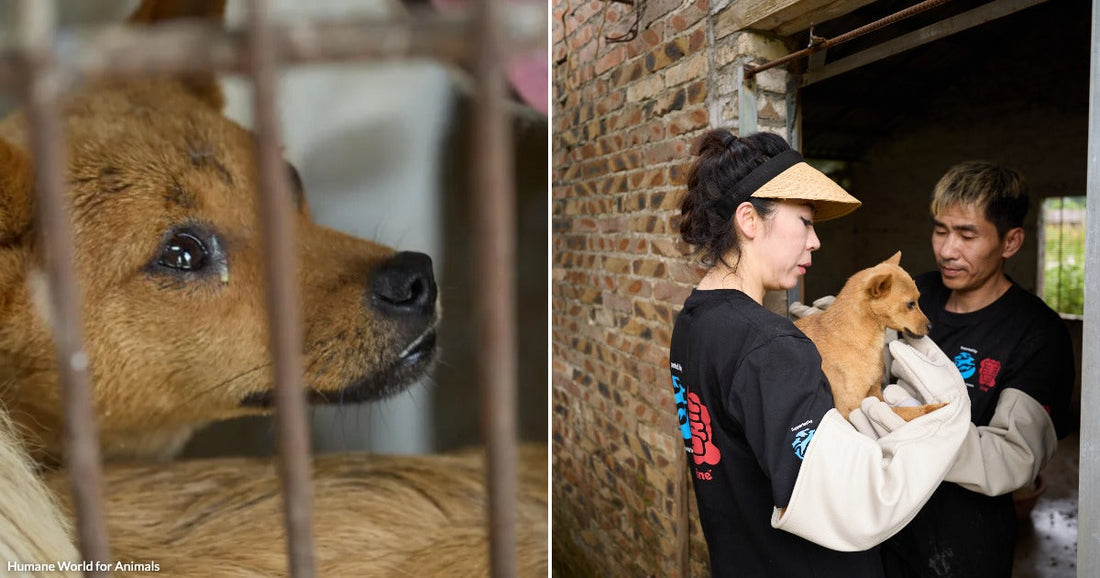
In a powerful step against the dog and cat meat trade in China, a notorious Yulin dog slaughterhouse has closed its doors permanently ahead of the city’s infamous dog meat festival. The closure, led by local and international animal protection groups, signals a new approach that focuses not only on saving animals, but also on providing humane, practical alternatives for those who have long depended on the trade for income. For anyone following the movement to end the dog meat trade in China, this slaughterhouse closure in Yulin is a striking and hopeful development.
The facility, located about 30 kilometers south of Yulin’s city center in Guangxi province, had reportedly killed more than 15,000 dogs since 2007. For nearly two decades, it supplied dog carcasses to restaurants and markets that capitalize on the Yulin dog meat festival. On average around 15 dogs a week were slaughtered there, with June being the most intense period. About 70% of the slaughterhouse’s annual income came from sales during the festival period, a reminder of how deeply the event has fueled cruelty and suffering.

The closure was made possible by a legally binding agreement between the slaughterhouse owner and the Vshine Animal Protection Association, supported financially and technically by Humane World for Animals, formerly known as Humane Society International. Instead of relying solely on law enforcement or public pressure, this approach uses an alternative livelihood model. It helps traders exit the trade by supporting them to transition into safer, more sustainable work that does not involve animal cruelty.
The owner, using the pseudonym Mr. Huang, expressed relief at the chance to leave the dog meat business behind. According to a statement translated by Humane World for Animals, he said he had been killing dogs for almost 20 years and called it a dirty business that left him feeling uncomfortable and conflicted. He also noted that fewer people are eating dog meat these days, which has made it difficult for him to support his family. With the help of the conversion program, he is now considering starting a breakfast catering venture, potentially serving rice porridge, fried dough and steamed buns. This shift represents both a personal turning point and an example of how humane solutions can work in practice.

Humane World for Animals
What makes this closure especially significant is that it is the first livelihood conversion of its kind in Yulin, a city widely known as a dog meat hotspot. Yulin’s so-called Lychee and Dog Meat Festival, which began only in 2010, was launched by traders aiming to promote dog meat consumption and boost profits. The event has often been portrayed as a tradition, but the source material makes clear that prior to 2010, the city had no history of commercial dog or cat meat sales. This relatively recent origin undercuts claims that the festival is a longstanding cultural practice and highlights instead its role as a commercial venture.
During the closure of the slaughterhouse, nine dogs were found alive on the property and were saved from slaughter. Among them were three dogs still wearing collars, strongly indicating that they were stolen pets. Rescuers named these dogs An An, a Labrador, Moli, a beagle, and Lian, a poodle. These names mark the beginning of a new life for them, and their stories underscore a disturbing reality: many dogs and cats killed for meat are not raised for that purpose but are taken from families and communities. The source notes that most dogs and cats slaughtered for food are stolen companion animals, guard dogs or strays grabbed from the streets, often using poison bait or darts.

Humane World for Animals
The rescued dogs are now receiving veterinary care and will be transported to Vshine’s shelter. There they will be quarantined, vaccinated and sterilized before being offered for local adoption into safe and loving homes. While these nine dogs represent only a fraction of the millions at risk across Asia, each individual rescue illustrates the real lives affected by the trade.
This Yulin slaughterhouse closure is part of a broader, region-wide program called Models for Change, run by Humane World for Animals. For more than a decade, the organization has supported dog meat farmers in South Korea to transition to new livelihoods such as chili and mushroom farming. The program has also expanded to Viet Nam, India and Indonesia, where similar conversion efforts help traders exit the dog meat economy. The Yulin case brings this model to one of the most controversial focal points of the dog meat trade in China.

Humane World for Animals
Julie Sanders, director of Humane World for Animals’ End Dog and Cat Meat campaign, described the Yulin conversion as incredibly exciting, especially in such a well-known hotspot. She observed that support for the dog meat trade is low even in places like Yulin and that many traders are eager to leave the business due to financial and family pressures. Her comments emphasize a central theme of the program: the dog and cat meat trade is not only cruel, but also increasingly unpopular, often illegal and economically insecure.
The article also highlights important context about the dog and cat meat trade in China and across Asia. China is believed to have the world’s largest dog and cat meat market, slaughtering an estimated 10 million dogs and 4 million cats each year. Despite these large numbers, most people in China do not consume dog or cat meat, and major cities such as Shenzhen and Zhuhai have banned the practice. Across Asia, the slaughter and sale of dogs and cats for human consumption is explicitly banned in Taiwan, Hong Kong, the Philippines, Thailand and South Korea, with the South Korean ban set to come fully into force in 2027. In places like Singapore and Malaysia, existing laws on animal welfare and food hygiene effectively block the trade, and it is also prohibited in Siem Reap in Cambodia as well as in 121 regencies, cities and provinces across Indonesia.
In China, the legal picture is also shifting. The article points to China’s Food Safety Law, which prohibits processing food from non-food animals. Since national and provincial slaughter regulations do not apply to dogs and cats, the dog and cat meat trade is described as being in violation of the law. Vshine has submitted a legislative proposal to the National People’s Congress calling for stronger companion animal protection and a nationwide ban on the dog and cat meat trade. The combination of legal pressure, public opposition and alternative livelihood programs may create the momentum needed for lasting change.
From the viewpoint of local activists, the conditions inside facilities like this Yulin slaughterhouse are deeply distressing. Chen Xiaolei from Vshine described entering the building as very disturbing, knowing that countless dogs had been killed there in brutal ways. Chen stressed that this cruel and dirty trade has no place in modern China and called the Yulin dog meat festival a stain on the country’s international reputation. The hope expressed is that by helping traders move into new lines of work, authorities in Yulin can finally close the dog and cat meat trade for good and set an example for other regions.
I found it particularly striking that both the former slaughterhouse owner and the activists are looking toward the same outcome: a more peaceful, stable and lawful way of life. The dog meat trade is depicted not only as an animal welfare crisis but as a system sustained by theft, illegality and health risks, including the spread of rabies. Efforts like the Models for Change program show that ending such a trade does not have to mean abandoning vulnerable people to poverty. Instead, it can mean building pathways to safer livelihoods that respect both human and animal well-being. In this sense, the closure of one slaughterhouse outside Yulin is more than a local story; it is a concrete example of how change can be achieved when compassion, legal frameworks and practical support come together.